

The Best Great Barrier Reef & Neurodivergent Families


We got maybe five hours of sleep.
Glass bottle. Police. Midnight move. Two kids transferred to new beds in the dark. If you read Part 3 you know. If you didn't — go read Part 3.
The point is: we woke up exhausted, made breakfast in our new unit because that's what you do when you have a kid with ARFID and a kitchen, got on a shuttle, and headed into the oldest rainforest on Earth.
No big deal.
The Daintree: Older Than You Can Actually Comprehend
The Daintree Rainforest predates the continental split. As in — this forest existed before the landmasses of the Earth separated into the continents we know today. It is one of the oldest ecosystems on the planet and it looks exactly like what that means. Ancient. Dense. Alive in a way that feels different from other forests.
Our guide was wonderful. Warm, patient with the kids, genuinely passionate about everything he was showing us. The shuttle picked everyone up and he talked the entire drive — which for my son, who processes information best when it's coming at him verbally, was actually perfect.
First stop: a crocodile boat tour on one of the murky rivers that wind through the rainforest. Crocodiles are not an abstraction in Australia. They are a real and present danger in these waterways and the guides do not let you forget it. We got some genuinely dark stories about crocodile encounters that I could have done without — but the kids were riveted, so there's that.
The boat guide was a little flat. Fine, just not particularly enthusiastic. The crocodiles, however, were not flat. So we managed.
Then lunch at a small rainforest café run by a married couple who came out and talked about the native fruits of Australia and the history of the land. The food was so-so. The conversation was genuinely interesting. Sometimes those two things just coexist and that's okay.
The hike itself is only about a mile. They list an age minimum on the tour because they don't want a group of eight people held up by a toddler who doesn't want to walk. I reached out ahead of time and explained that my kids have done real hiking before and we'd be fine.
They said no problem. They were right.
The trail winds up through the rainforest while the guide points out the plants — because in the Daintree, the plants are the danger. Not the animals. The plants. There are species in there that will ruin your day with a single brush of contact. Our guide knew every one of them.
We hiked up. We reached the waterfall.
It was freezing. Genuinely cold in a way that feels impossible when you're standing in a tropical rainforest. But we got in. The guide had pool noodles. I had a life jacket strapped to my backpack for the entire hike — one mile, uphill, life jacket on my back — because that's just the kind of mom I am.
We swam. It was beautiful. It was cold. I would do it again immediately.
Now. The bug spray lesson.
I applied bug spray at the beginning of the day over my clothes, which was smart. What was not smart was failing to reapply when I changed into my bathing suit at the waterfall. The areas of my body that were no longer covered by clothing were no longer covered by bug spray.
By the end of the day I had been eaten alive from the waist down.
My husband had the same experience.
The kids were fine. Naturally.
Wear bug spray. Reapply bug spray. Reapply it again. This is not optional in the Daintree.
Every Single Person on the Boat Is a Marine Biologist
The next morning was Wavelength.
This is the one. If you are going to the Great Barrier Reef with a neurodivergent child — or honestly with any child — this is the tour you book. Small group by reef standards, about 38 people, which sounds like a lot until you realize the other options are double that. Every single staff member on board is a marine biologist. Not a guide who knows some facts. An actual marine biologist who chose to be here because they love this reef.
You feel that difference immediately.
We found the boat in the harbour, got on, and within minutes someone had fitted my son with the right mask — really fitted, checking the seal, making sure it worked. That attention to detail set the tone for everything that followed.
It's about an hour and a half out to the open ocean reef. Which gave us time.

The Fish Diagram Moment
Somewhere on the way out, my son mentioned to one of the lead marine biologists that he wanted to see a GT — a Giant Trevally, a fish he'd learned about from a nature documentary. Without missing a beat, this man brought him over to the diagram on the wall — a detailed illustration of every species you might encounter on the reef that day.
And he just sat with him.
Ten minutes. Maybe more. Going through every fish. Answering every question. Letting my son lead the conversation wherever it went.
There was no agenda. No rush. No moment of "okay buddy that's enough." Just a grown man genuinely connecting with my kid over fish.
I stood back and watched and felt something loosen in my chest that I didn't even know was tight.
Three Spots, Two Sharks, One Turtle, and a Clownfish
Wavelength takes you to three separate snorkeling locations — an hour at each. You can go in and out of the water as much as you want. Nobody is watching a clock.
The first spot was great. Good coral, plenty of fish, the kids settling into their rhythm.
Getting out of the water after that first hour was when things got hard.
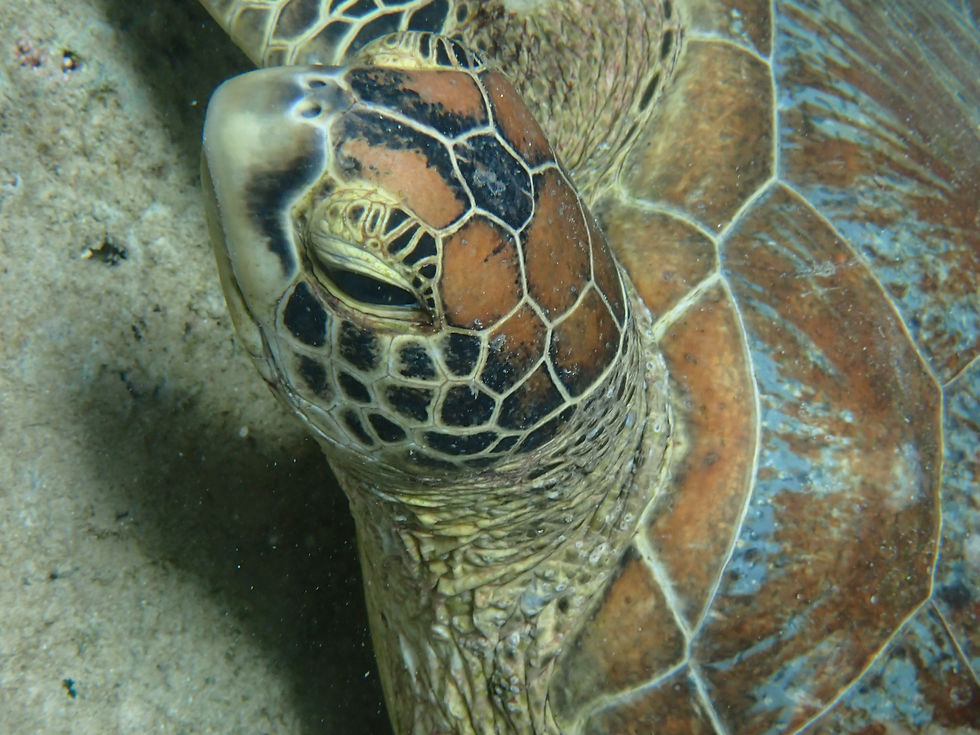
Someone on the boat spotted a turtle. And my son hadn't seen it.
If you have a neurodivergent child you know how this goes. The missing of the thing
became the only thing. He started to spiral — I don't want to be here, I want to go home, I want to go back to California. End of trip fatigue plus genuine disappointment plus the particular anguish of everyone else seeing something you missed.
I held the line. Kept my voice steady. Told him we had two more locations and two more hours and this wasn't over.
He heard me. Eventually.

The second spot brought us clownfish in anemone — exactly the image you picture when you think Great Barrier Reef. Real. Right there. My son's face through his mask when he saw it was worth the entire flight.

Then came the third spot.
We jumped in and almost immediately someone pointed — turtle. Right there. Resting on the sandy bottom below us.
We swam hard. I had one kid, my husband had the other. We got there.
We waited.
Turtles come up for air.
This one did. It rose slowly off the bottom, came up right past us, broke the surface, breathed, and went back down.
My son was right there for all of it.
On the way back from the turtle we swam past a black tip reef shark. I saw it clearly. I did not alert the children because we were having a moment and I wasn't about to derail it. My husband saw it too. We made eye contact above the water and kept swimming.
Some things you process later.
What the Great Barrier Reef Actually Is
I want to be honest about something before I close this out.
The Great Barrier Reef is not always crystal clear blue water teeming with fish in every direction. The conditions change. Weather affects visibility. Cyclones churn up the water column for weeks. Climate change is real and the reef is feeling it.
What it is — what it always is — is one of the most extraordinary living systems on Earth. The coral alone is worth the trip. The fish are worth the trip. The moment your kid sees a turtle rise from the bottom of the ocean and break the surface ten feet away from his face is worth every hour of travel, every stinger suit, every paddle board in the rain, every glass bottle through every window.
We came to Australia because my son loves nature. Because he had already studied this reef through screens and documentaries and wanted to see it for real.
He saw it for real.
That's the whole story.


Comments